

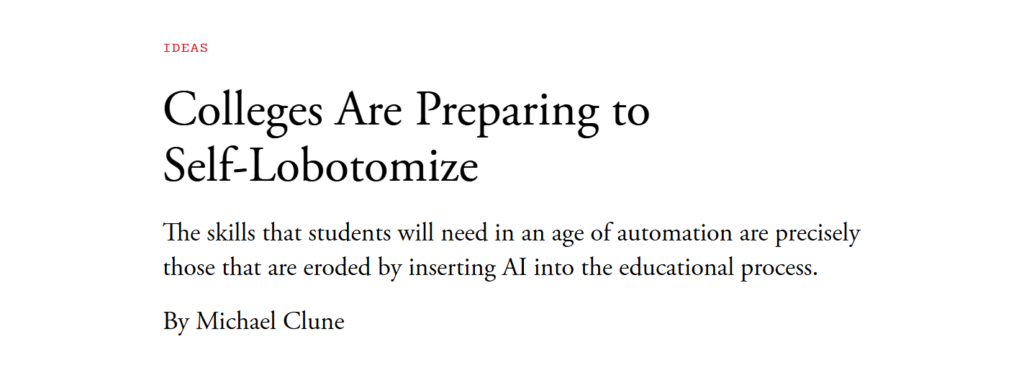
Did you see The Atlantic article titled ‘Colleges are preparing to self-lobotomise’?
It was all about the erosion of critical thinking at universities where students generated essays with AI, only for professors to mark with AI.
They skipped the writing altogether. And that’s a problem, because, well… what is writing?
If you wanted a fancy description, I’d say:
Writing is the symbolic representation of knowledge.
Putting pen to paper has everything to do with high-quality thought. To write, you have to pay attention, organise your ideas and listen to your intuition. And once your thoughts are on the page, they can be analysed, criticised, copied and changed.
The work goes on – and it’s really, really good for your brain.
The 7 brainy abilities you can release by writing
1. Join dots
In the early 2000s, more than 4,000 American schools came together to investigate the skill of writing. What did they discover?
Writing is how students connect the dots in their knowledge.
If you want to develop as an expert, take the jumble of ideas in your mind and find patterns. Join the dots through writing.
2. Judge evidence
Writing can also help you chuck out arguments that are incomplete or misleading.
Professors Jessica Naber and Tami Wyatt tested the reasoning skills of university students. Most came to the test without doing any extra work; others arrived after doing writing exercises.
That second group performed best. Their brains were engaged and ready to make judgments.
3. Gain clarity
Writing makes you better at understanding the world. But does it make you better at understanding yourself?
Psychologists Daniel Donnolly and Edward Murray compared writing to talking therapy – offering treatments to 100 university students.
Writing changed behaviour, thinking and self-esteem, remarkably like a chat with a therapist.
4. Release tension
There have been hundreds of studies demonstrating the positive impact of putting feelings into words. But James Pennebaker ran the original experiment.
He asked people to write about a stressful or traumatic experience for 15 minutes a day, over 4 consecutive days. Those who followed these instructions had brighter moods and lower stress levels. They were less likely to go to the doctor afterwards.
5. Boost memory
Expressive writing also improves your memory.
A pair of psychologists tested this. Klein and Boals told one group to write about stressful feelings, and another to write about random topics.
Members of the first group had fewer intrusive thoughts. They had clearer minds and, as a result, scored higher in memory tests weeks later.
6. Absorb learning
Writing makes learning a sensory experience. That’s another way writing supports memory.
A slew of academics – including Nobel Prize-winner Daniel Oppenheimer – have looked at the benefits of note-taking.
People who go through the sensory, manual process of hand-writing notes have better recall than a) people who type, and b) people who just sit and listen.
7. Build creativity
Write regularly and your brain will change to make you more creative. This was proven by the neuroscientist Martin Lotze with a series of scans. He found differences between the brains of expert writers and those of non-experts.
His conclusion wasn’t that there are people who were born to be writers, because of their special wiring; it was that you can reshape your brain if you spend enough time crafting sentences.

TL;DR
Writing today is not a frill for the few, but an essential skill for the many.
And that’s straight from the National Commission on Writing in America’s Schools and Colleges. So when you next want to join dots, judge evidence, gain clarity, release tension, boost memory, absorb learning or build creativity, reach for your pen.
Aidan Clifford writes for Pinstripe Poets – artists who love their day jobs.