Category: Write like the greats

  • WLTG: Practical politics

    From The Grapes of Wrath

    My first formal title was Efficiency Planning Manager. And the role was bestowed with ceremony.

    My boss clicked through vast spreadsheets and explained the title’s constituent parts. 

    ‘Efficiency’ was when the numbers went down — a good thing, something to be desired: 

    So said my boss. Which I translated in my head as:

    And then, thinking frantically:

    Setting targets for firings. Nagging leaders to make the cuts. Recording the rounds of corporate bloodletting. 

    On good days, I lost myself in the abstraction. I recorded efficiency gains in columns that rippled with colours (angry reds, happy greens). 

    On bad days, I felt like a drone operator, sitting in a cubicle in a pressed shirt, maiming people from afar.

    Click. There goes your career, Cell G3349. Click. Click. Postpone that mortgage application, Cell G5287. 

    Seeing the person was my mistake. My career as an Efficiency Planning Manager was soon over and I picked up the duties of a National Development Manager. Much more… constructive.

    Why those acronyms? Why the advanced level of abstraction? Because if we were honest about our occupations, we might be ashamed. 

    I read a lot while I held those jobs. Dad had a new flat with room for me, and I was grateful. We admired the big empty rooms. And put off buying furniture or getting a TV. 

    Books we welcomed. They propped open doors and served as coasters. Stacks grew from the carpet like stalagmites. Piles of crushed spines, bearing masculine titles. For Whom the Bell Tolls. Down and Out in Paris and London. The Call of The Wild. 

    Steinbeck was my favourite. Other novels were picked up, set down, floated about the flat. The Grapes of Wrath stayed anchored by my bedside. 

    When I was hollowed out after a day of efficiencies, Steinbeck stirred my soul.


    His book followed an uprooted family as they sought work. He made the Joads seem giant in spirit, while explaining why they were unremarkable in the extreme. 

    Unremarkable, because a system was running 1930s America. Climate punished the innocent. Corporations bled them dry. And Steinbeck, first as a reporter, then as an author, documented the organised violence around California’s orchards. 

    That achievement of Steinbeck’s would have been enough to make him important to me as I updated spreadsheets. He sharpened my despair — and then tempered it into resolve.

    Reading The Grapes of Wrath, you side with the migrant farmers, with the Okies and the Joads. These are people who know and love the land. Their honest need to work is more dignified than rich Californians’ obsession with value, price and yield.

    If you don’t understand what your work means in the world of objects and people — if you await results that can’t be perceived by sight, smell, taste or touch — stay your hand. You might be fermenting the grapes of wrath. An efficiency with great cost.


    Aidan Clifford writes for Pinstripe Poets – artists who love their day jobs. This post is part of a series called ‘Write like the Greats’. See the rest here.
  • WLTG: Factual fables

    From In Cold Blood

    So let’s make room for the genre and its tensions and its foibles.

    Let’s talk about two dramas. One serialised on Netflix. The other in The New Yorker, 60 years prior.

    Baby Reindeer was mandatory viewing in 2024. Richard Gadd played himself, reliving the abuses he’d suffered as an aspiring comedian.

    The title was absurd and chilling. It was the pet name pinned to Gadd by his stalker. It featured in thousands of messages.

    Gadd was haunted at work, at home, online.

    His stalker sent 46 Facebook messages, 744 tweets, 41,076 emails.


    She recorded pleading, abusive, explicit monologues to Gadd’s voicemail. 350 hours in total.

    He could’ve listened to his stalker for two whole weeks. And the remarkable thing was…

    … he did.

    Gadd reviewed his stalker’s raving, so he could devise a one-man show:

    Baby Reindeer struck the Edinburgh Fringe, then struck a deal with Netflix. Streaming hauled the case into the public consciousness.

    It featured real emails. Real texts. We could read them for ourselves. And each episode opened with the claim:

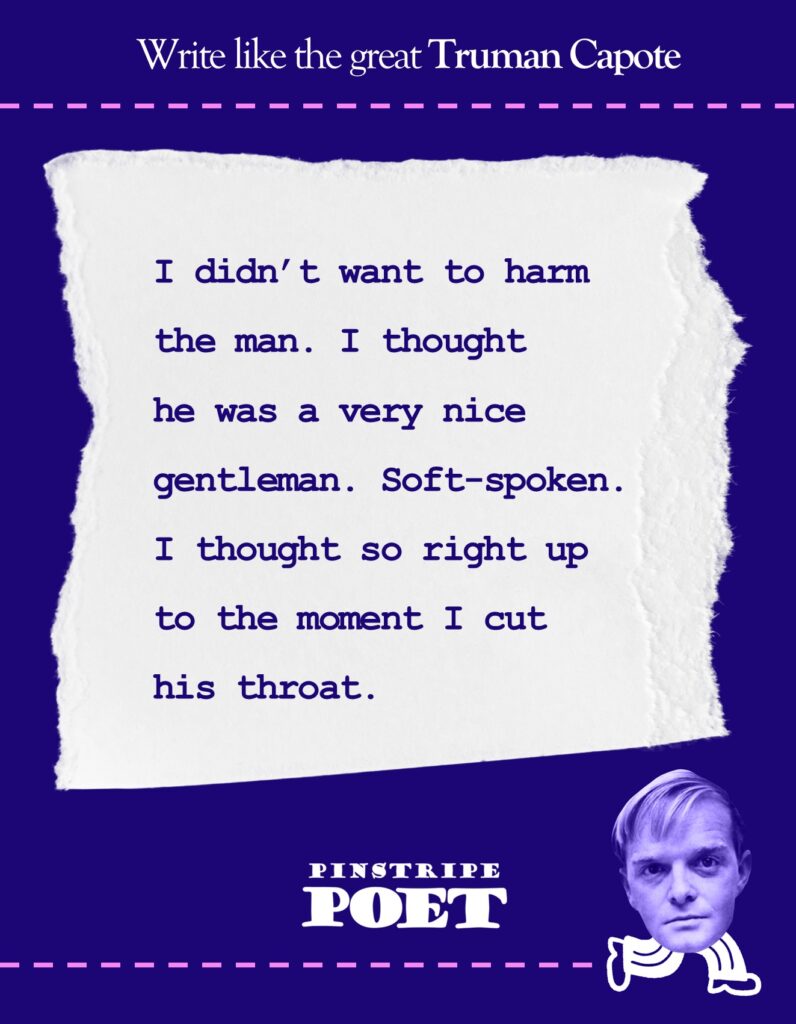
    Extraordinary — but precedented. The novel In Cold Blood, published in 1966, was subtitled:

    Back in time, Capote was coaxed from the comfort of New York by the scent of slaughter.

    It issued from a farmhouse in Kansas. This was 1959. The New York Times ran the story:

    It came deep inside the paper, but caught the writer’s eye. Capote recalls:

    The kind of book Capote wanted to write was a ‘non-fiction novel’ — a concept he’d been turning over in his mind, until it was worn as a beachcombed pebble.

    What would it mean to make art out of reality? Would journalism change if given three hundred pages rather than a single spread?

    Like Gadd, Capote couldn’t begin his work until he was drowned in material:

    Visit the writer’s archive and you can leaf through 14 folders, run your finger along timelines, smooth the creases from hand-drawn maps.

    And amongst it all, quotes from the people of Kansas, full of winsome rural wisdom:

    Contrast that with the cynicism of the feckless killers, also recorded by Capote’s steel mind:

    Those quotes are as characterful — and as revealing — as the voicemails on Gadd’s mobile.

    Well, visiting hours are almost over at the archive. You’ve just enough time to skim the press galleys of In Cold Blood. And I have to turn your attention to the notes in the margin.

    Capote’s editor at The New Yorker was fretful. In one place he scribbled:

    In another, simply: 

    The veracity of In Cold Blood has been contested since the year it was published.

    A reporter from Esquire spoke to the same Kansas residents as Capote — and found their recollections differed from the words Capote plopped in their mouths.

    No surprise. Given Capote interviewed without tape machine or notepad. He relied on his prodigious memory to preserve the testimonies of waitresses and farmhands.

    The Esquire reporter concluded:

    And that’s another reason to treat In Cold Blood as a precursor to Baby Reindeer, as Netflix came to regret the promise that they were telling a true story.

    Gadd manipulated events to manage his audience’s interest, fixing them to the sofa as the series rolled on:

    Capote’s serial was also gripping. But it had the qualities of a fable too. By massaging the details of the murder (such as amplifying the folksiness of Holcomb farmers), Capote could depict two contrasting visions of America:

    There was something bigger at stake.

    Gadd made similar arguments: he was reaching for a more essential story. And he was worth listening to as someone who was simultaneously victim and author, researcher and subject.

    As for Capote, he came close to admitting the true nature of his masterwork. After seeing the 1967 movie adaptation of In Cold Blood, he wrote:

    Aidan Clifford writes for Pinstripe Poets – artists who love their day jobs. This post is part of a series called ‘Write like the Greats’. See the rest here.

  • WLTG: Rhythmic repetitions

    From One Thousand and One Nights

    The Ark of the Covenant goes into a crate. A hammer slams, driving a nail. The lid fits tight, wood on wood, hiding the Ark from view. Anonymous hands snap on a padlock and a government employee (flat cap and flat expression) guides the crate along the gangway. The Ark becomes a box among thousands.


    Some collections exist to conceal. Others exist to display. Few are copious enough to contain the wonders of centuries. But I’ve just come across literature’s equivalent to the Raider’s warehouse — and the crates are wiiiiide open.

    Which puts me in a bind, because I like to credit authors, but the tales just weren’t written that way. There’s no single scrivener or orator to point to. The book is the product of generations of tellers, curators and translators.


    So let’s credit the fictional storyteller Shahrazad. The book begins with that character and her tale is the one that envelopes the other rich narratives. Her qualifications?

    Her quandary? Her husband intends to put her to death… just as soon as he hears the end of her story. So in order to survive, Shahrazad becomes a character revealing characters who share their own fables, histories and adventures.

    The result is a series of surprises that feels like touring the warehouse in Raiders. Or traversing dreams in Inception. Or tuning your radio to stations in ancient Persia, India, Greece…


    Do that for a thousand and one nights, and you should feel disorientated and groggy. But no. Shahrazad gives her audience moments of stability. They are islands where we can rest, gather our thoughts, remember the pattern of the book, and prepare for the next chapter.

    Full title: ‘Sindbad The Sailor and Sindbad The Porter’. Did you know about the porter? He doesn’t loom in our culture like his name-fellow. The porter matters, though, because offers the reader stability. He’s a stand-in.

    The porter’s summoned to a magnificent estate, where he’s entertained by a wealthy adventurer who happens to share his name:

    Thanks for bearing with. I wanted to give you the merchant’s full speech, because it is stuffed with reassurances for the reader:

    1. There will be drama (danger and hardship).
    2. There will be a broad narrative arc (the rise to wealth).
    3. There will be seven episodes (the voyages).
    4. There will be a greater lesson (about Fate).

    And if that wasn’t enough reassuring predictability, Shahrazad closes each episode in the same way.

    An evening of feasting and storytelling winds down. The porter is thanked for his company and given a hundred pieces of gold. The porter then leaves, sleeps, wakes, recites prayers and returns for another tale.

    You see why the book is hard to put down. You want to see the porter get richer. You want to hear another of the sailor’s near-misses.

    The rhythm pushes you onwards, but the possibility of a full and fully satisfying ending retreats. It’s somewhere beyond the crest of the next tale.

    Aidan Clifford writes for Pinstripe Poets – artists who love their day jobs. This post is part of a series called ‘Write like the Greats’. See the rest here.

  • WLTG: Excruciating excavations

    From Starve Acre

    The play ended with a girl leading her father beyond the city walls.

    The girl was Electra. The man, Oedipus. The city, Thebes. Perhaps those names strike dissonant cords of memory.

    As they exited the tragedy, the outcast king questioned whether his people were at peace.

    He’d put out his eyes to break a curse, to make water return to his parched land. Now his shirt was soaked with blood and rain — but were his people glad?

    Actors, who I’d seen dance for hours, sat on stage and breathed. They’d delivered the story to its only conclusion.

    I almost said ‘to its only logical conclusion’, but logic was one of the weaker forces on-stage. Sin and superstition and emotion had far greater influence over events.

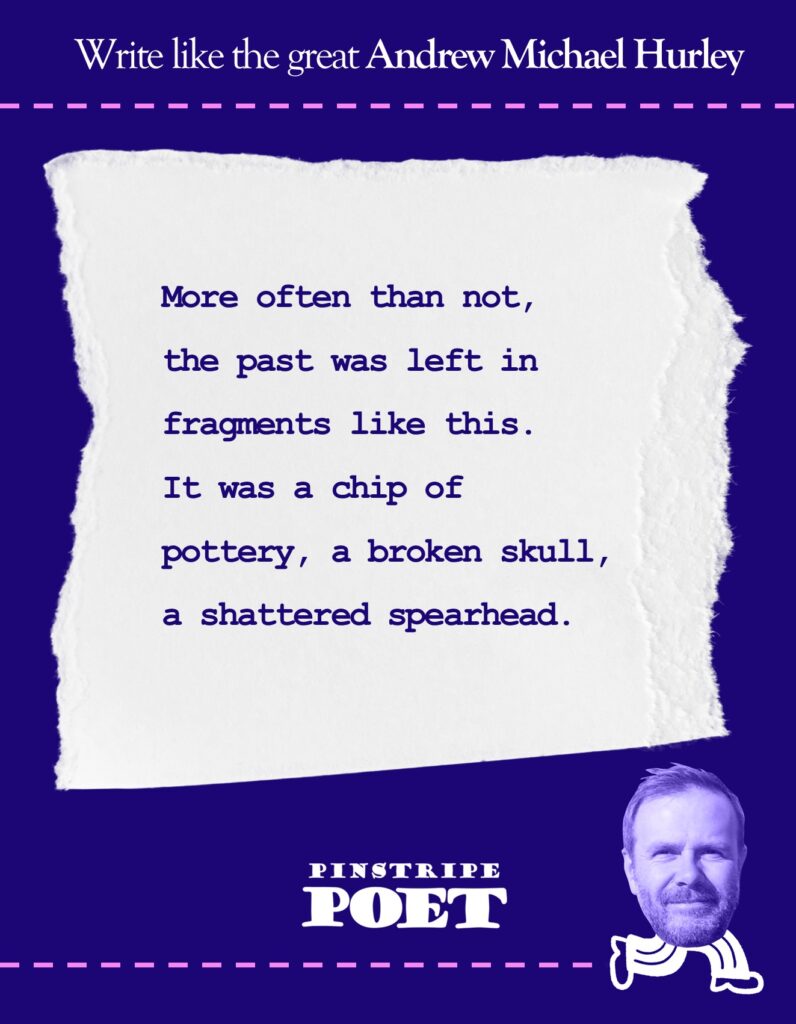
    A play written in ancient Greece by Sophocles, adapted by Ella Hickson in 2024, reminded me of a horror novel by Andrew Michael Hurley.

    Both feature rational men grappling with the supernatural.

    Both propel their plots through revelation. And that’s the technique I want to pick apart, today.

    So, tracing the course of action and reaction in both stories, what do we notice?

    Evidence emerges, complicating and clarifying crimes. But it emerges from unusual sources.

    In Oedipus, understanding comes from oracles, prophets and servants breaking old oaths of secrecy.

    In Starve Acre, it bubbles up from psychics, relics and tattered woodblock prints.

    It’s the rational protagonist, Richard, who owns the barren farm called Starve Acre. When we meet him, he’s enduring winter in his silent home, haunted by recollections of his recently deceased son — and of his own boyhood.

    The memories overlap, because Richard grew up on the farm. Then he inherited it as an adult — a tumbledown estate that included his father’s library.

    Putting it right, Richard finds prints of the neighbouring fields.

    The hunt is called early in the book and winds until two pages from the end. Prints appear at judicious moments, deepening the dread of the reader, who can feel the past polluting the present.

    No wonder the author made Richard an archaeologist, scraping in the dirt. It’s dangerous to raise bodies from the ground. Dead men can tell tales.

    Aidan Clifford writes for Pinstripe Poets – artists who love their day jobs. This post is part of a series called ‘Write like the Greats’. See the rest here.

  • WLTG: Vulgar tongues

    From The Divine Comedy

    Probably not, because who writes poetry anymore?*

    Modern pen-pushers are busy with blogs, emails and social posts.

    But we should remember the medieval poet Dante Alighieri. (And not just because it’s Valentine’s Day and he was drippingly romantic.)

    We should remember him for his push to reach people — for writing to the broadest possible audience.

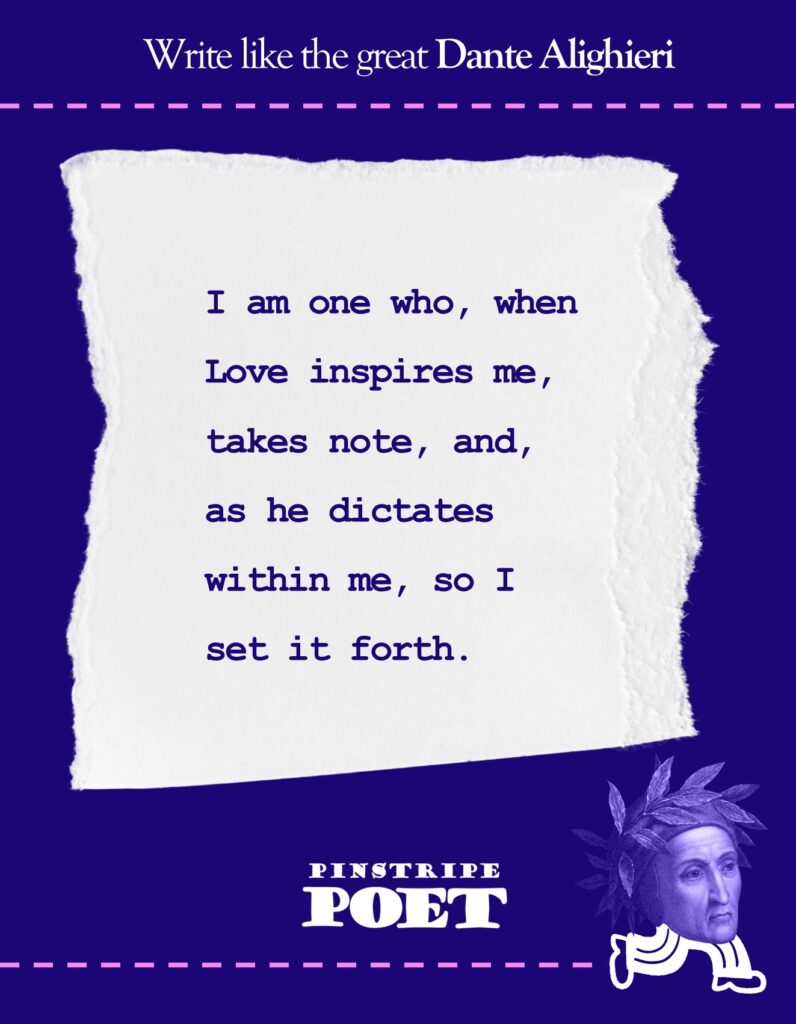
    You see, Dante had a theory. (It’s all spelt out in an essay titled ‘On Eloquence in the Vernacular’.) He argued that ordinary language could be used for extraordinary art.

    Poetry didn’t need to be composed in Latin. The dialects of Italy had a music all of their own.

    And that meant artists could — and should — address the living, breathing people of Florence, instead of the ghosts of the Roman Empire.

    And sure, Dante made that argument in Latin. (Ironic…) But his masterpiece was in ‘vulgar’ language.

    And generations of adoring readers agree: the language was up to the task. Hell, purgatory and heaven could be spoken of in the common tongue.

    So the next time you’re dealing with a difficult stakeholder… who’d prefer if you used fancier, Latinate words…

    He championed his native dialect so skilfully that it effectively became the language of a whole country. 

    Because, in a final flourish, I’ll reveal that Dante and The Divine Comedy are significant chapters in the story of how Italian became Italian. Or as some know it, la bella lingua.

    The beautiful language.


    *I do, but that’s beside the point.

    Aidan Clifford writes for Pinstripe Poets – artists who love their day jobs. This post is part of a series called ‘Write like the Greats’. See the rest here.
  • WLTG: Extreme exaggerations

    From High-Rise

    I realised that while hammering out an essay on Jules Verne.

    Verne conceived of Twenty Thousand Leagues Under the Sea after seeing a submarine — well, a model of one — at the world fair.

    So a machine that took passengers under water existed in 1867.

    Verne’s innovation was making the technology sleeker, grander, faster — capable of wonders:

    Once Verne had conceived of a submarine with sodium-mercury batteries and floodable tanks, he could derive the rest of his plot.

    A craft like Nautilus could travel for 20,000 leagues under the sea. It would be a pity not to make the journey.

    But I have a frustration with A Thousand Leagues Under the Sea. Because ripples from the invention don’t reach wider society.

    What happens under the sea stays under the sea. And that leaves a lot unexplored.

    This thought strikes me, because I’ve just read High-Rise by J. G. Ballard — a science fiction author who more sociologist than inventor.

    Ballard was writing a hundred years after Verne. Submarines had gone nuclear. Skyscrapers propagated like mushrooms.

    He lived in a city enamoured with concrete. London poured the material into high-density building projects: Balfron Tower, Trellick Tower, The Barbican.

    Those developments were big. So Ballard went bigger in his novel High-Rise.

    If Verne was turned on by engineering and inventors, Ballard was stimulated by architecture and theorists.

    Theorists like Newman who suggested that people need to be surveilled to stay civilised. Like Ehrlich who thought a ‘population bomb‘ would cause catastrophic overcrowding. Like Calhoun who stuffed rats into a box (this was science in the ’70s).

    They gave Ballard a set of anxieties to dramatise.

    Over the course of the novel, the middle-class residents devolve into:

    And they are exaggerations of the reader. You can choose your avatar.

    Will you be Anthony Royal, who attempts to restore order to the high-rise?

    Dr. Laing, who passively follows events?

    Or Richard Wilder, who thrives on the carnage?

    These pure types — made by Ballard to represent the id, ego and super-ego — allow readers to tussle with themselves during passages of awful beauty.

    He enlarged the deliriums of a decade, so we can see where their shadows stretch into our own.

    Aidan Clifford writes for Pinstripe Poets – artists who love their day jobs. This post is part of a series called ‘Write like the Greats’. See the rest here.
  • WLTG: Scientific speculations

    From Twenty Thousand Leagues Under the Sea

    The way scientists and writers interact — I’ve seen it described as a codependency.

    Authors take inspiration from science.

    Their stories expand what readers can imagine.

    Those readers include scientists who engage with experimental ideas.

    They pull on pristine lab coats and test whether fictions could enter reality.

    Jules Verne saw a model of an early submarine at a world fair in 1867.

    He wrote Twenty Thousand Leagues Under The Sea.

    The submarine from Twenty Thousand Leagues Under the Sea: Nautilus


    The book was read by an engineer called Simon Lake.

    Lake built a submarine incorporating Verne’s fantasies: ballast tanks for stability… diving planes for control… Breakthroughs that redrafted what a submarine could be.

    Argonaut Junior, made in 1894.

    At least in the field of psychology, codependecy describes a relationship that’s unbalanced — askew.

    One person enables the destructive behaviour of the other.

    And when you list the inventions ripped from fiction, the roll call is chilling: Tasers, atomic bombs, chemical weapons.

    It’s as if blueprints for modern violence were encoded in stories, awaiting discovery.

    And readers have been better at taking author’s ideas than their warnings. So codependent is right.

    If you’ll excuse me, I’ll be reading “Dial F for Frankenstein” — an Arthur C. Clarke story about the dangers of intelligent networks.

    I can’t imagine it will have anything to say about the spread of AI…


    Aidan Clifford writes for Pinstripe Poets – artists who love their day jobs. This post is part of a series called ‘Write like the Greats’. See the rest here.

  • WLTG: Skipped steps

    From Yellowface

    Yellowface winks obscenely from bookstore shelves. It stimulates. It sets the machinery of the mind in motion… and then jams its gears.

    The reader gets the term is racially charged. Recalls ‘Blackface’ – yep, that’s a thing. Thinks of Mickey Rooney in Breakfast at Tiffany’s. But that’s about all they can manage.

    How does that relate to the eyes in the cover art, eyes which avoid inspection?

    Cover art for Yellowface

    All the bookstore browser can do is guess wildly.

    The cover tells them they don’t know squat. The first sentence (shared above) throws them further off-kilter.

    Okay. I give you full permission to unclench. I won’t spoil the novel.

    I won’t pull quotes from the depths of its sleek interior; doing so would be like dragging props from a haunted house.

    Looking at Kuang’s tricks in isolation would be educational. But it would dull the shock of reading the book and catching the fairground ghouls in context.

    Let me leave most ghosts un-busted.

    We won’t go further than her opening line – but that’s enough to make you want to read the whole darn thing.

    There are terms for a book that dilates your pupils and parches your throat. It’s a page-turner, suspense novel, thriller.

    And in Yellowface, Kuang has engineered a haunted house-rollercoaster hybrid.

    The stakes are high. The protagonist: floundering. And the reader (speaking for myself): strapped in for the ride.

    She opens ‘curiosity gaps’: she dangles the prospect of knowledge, but withholds it until it is earned.

    When Kuang writes, “The night I watch Athena Liu die…” she skips ahead. She flaunts future events in a way that moves the reader ahead of the action.

    From that acrophobic position, they’re left to wonder, “How will the story fill in the blanks?”

    Often, readers know how a chapter is going to climax. But as to how will the plot ratchet to that giddy height… Kuang keeps that back.

    Her message – the same message as is beamed by title, cover and blurb – is firm: “Read on and find out.”


    Aidan Clifford writes for Pinstripe Poets – artists who love their day jobs. This post is part of a series called ‘Write like the Greats’. See the rest here.

  • WLTG: Family histories

    From White Teeth

    That becomes clear on the first page of White Teeth, when a despondent Archibald Jones tries gassing himself.

    The act should have ended Zadie Smith’s novel before the debut had properly begun. But…

    Archie survives to reach an ‘End of the world’ party that’s petering out in a North London suburb.

    Defying apocalyptic prophecies, the world is alive and well on 1 January 1967. In fact, it seems to spin faster than ever, because…

    A chance meeting leads Archie and Clara to the altar, and Zadie Smith to a problem: How did the marriage come about?

    History enters as the central character of White Teeth:

    Clara marries Archie, because of a love affair gone sour.

    That affair began because Clara was door-knocking for the Jehovah Witnesses.

    She was proselytising because her mother, Hortense, was a devoted member of the church.

    Hortense was devout, because the church gave her a feeling of security she had lacked, ever since she was born during an earthquake.

    And why? We can keep asking.

    Why had her mother, Ambrosia, given birth as tremors brought down a church around her screams? Because she’d been left in Jamaica. She’d been left in Jamaica, because it was convenient for the English captain who’d got her pregnant. She stayed, because the earthquake convinced her that Revelation had come.

    Keep pulling threads and you’ll get tangled.

    It informs her present. Britain’s colonial past gives her a particular place in multi-cultural London. Jamaica influences the way she dresses, cooks and speaks. And a more recent, more personal history affects everything from her spirituality to her dental health (hence the title, White Teeth).

    There’s a reason Zadie Smith uses a line from The Tempest as an epigram:

    While I learnt about Clara and the generations above her, a couple were added below. Irie Jones — daughter of Archie and Clara — appears in later novels by Zadie Smith, turning White Teeth into a kind of prologue.

    So it’s ending isn’t any sort of conclusive ending, just as the beginning isn’t actually the beginning. The book is a slice of family history, which stretches backwards, which goes on.


    Aidan Clifford writes for Pinstripe Poets – artists who love their day jobs. This post is part of a series called ‘Write like the Greats’. See the rest here.

  • WLTG: Jagged juxtapositions

    From Hamnet

    There was snow last night, I’m told. By the time I was awake, it had been overtaken by grey drizzle.

    But the mind can play tricks. I can imagine the dancing snow, even as I look out on a pavement dressed in rain.

    The snowflakes would have whirled in the lamplight, like moths out of hibernation.

    They would have settled to reflect the sulphurous yellow.

    They would have been disturbed by foxes searching for scraps, disappearing in the early hours.

    It’s poignant to contrast the past with the present. Or to guess at what the future might hold.

    And these are the kind of temporal games that occupy us in early January, as we reflect on a lost year and hope that better days lie ahead.

    I’ve been darting around history thanks to three novels:


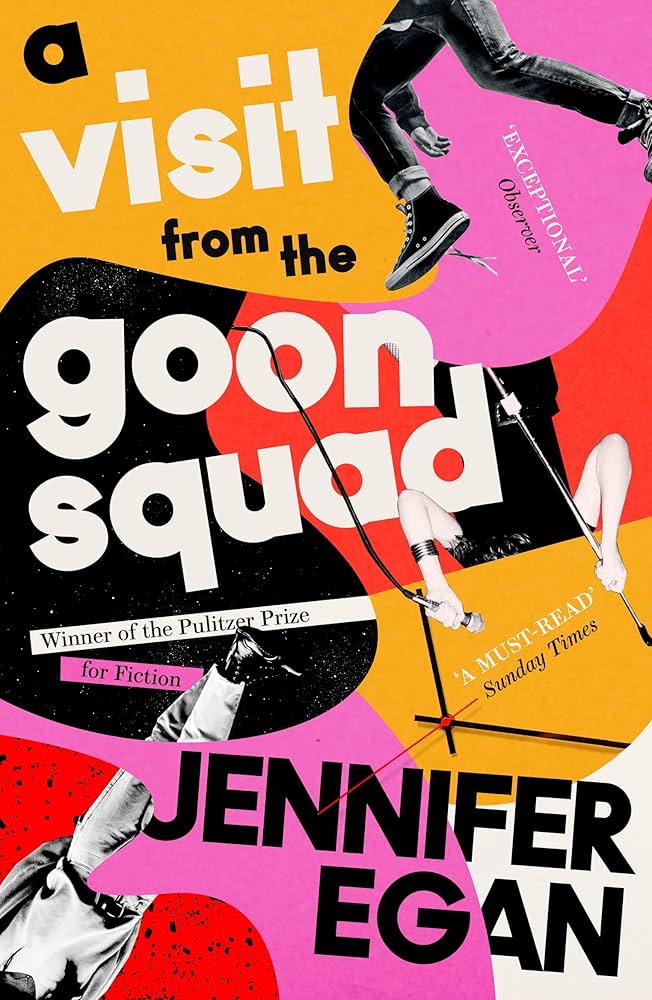
    A Visit From The Goon Squad, which was sometimes about the 1970s, sometimes about the 2010s, sometimes about the years in between.


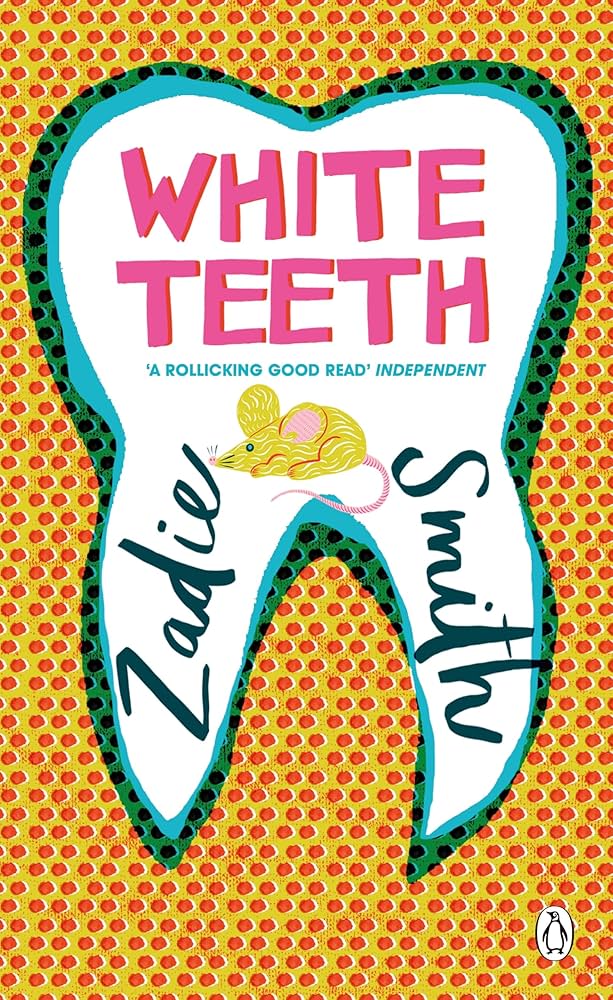
    White Teeth, which ranged even further. It had chapters about a 1857 uprising in India and a hurricane that hit Britain 130 years later.


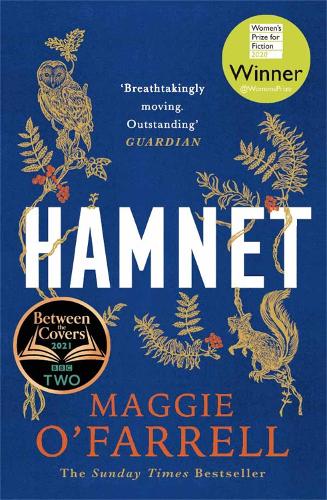
    Hamnet, which followed the historical figure Agnes Hathaway as she became wife, mother and witch.

    In those novels, time is an antagonist for men who had an appointment with glory, and missed it. For women who had beautiful boys, and lost them.

    In A Visit From The Goon Squad, Jennifer Egan showed the same cunning as Zadie Smith in White Teeth. Both books opened many windows onto their characters.

    Readers could peek through at the jumbled pieces of jumbled lives. They would have had to squint to see any evidence of Fate.

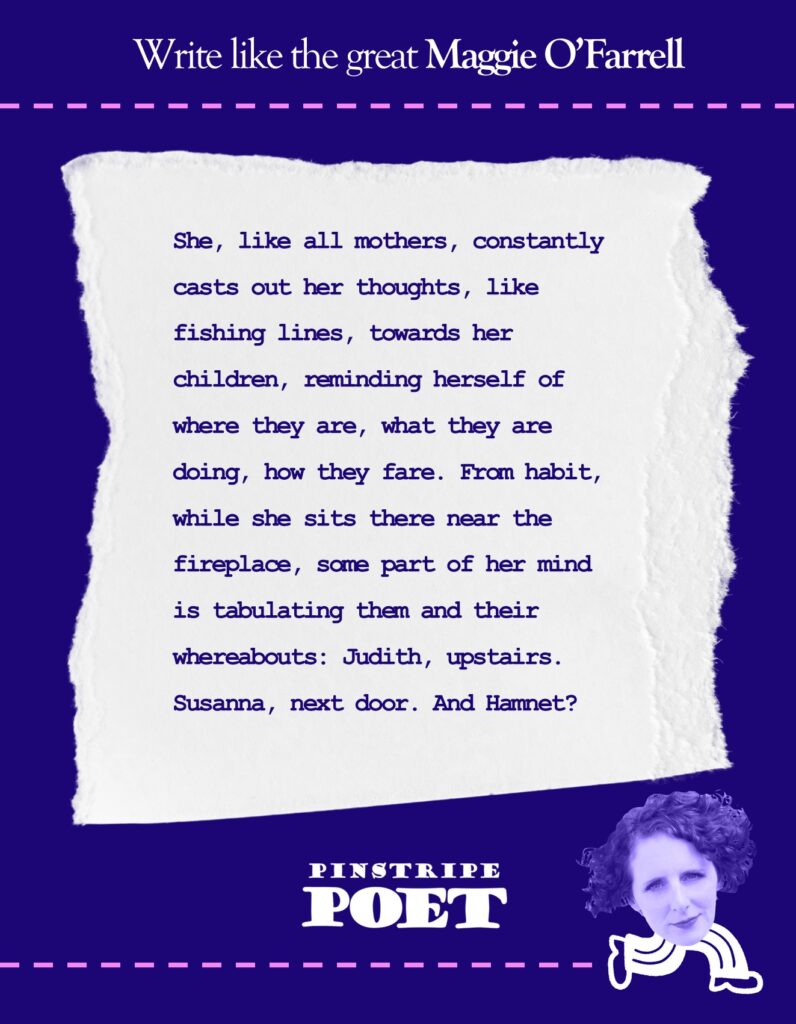
    I was gripped by the way Maggie O’Farrell manipulated time. Hamnet — a book that did believe in Fate — seized my heart and squeezed.

    O’Farrell stuck to a stricter schema than the other writers. Readers would tense at the end of each happy chapter, knowing the next wouldn’t be so kind.

    The reader gained that foresight, as Hamnet reliably switched between two epochs in Agnes’s life.

    One sparked by an encounter with a Latin tutor called Shakespeare.

    Another which unspools from the moment a boy — Agnes’s boy — descended the stairs in Stratford.


    From that moment, my panic only mounted. I’d be entranced by courtship, marriage negotiations and homemaking and then recall the death that was to come.

    It was almost enough to make me put the book down, so Hamnet could live longer.

    Can you recognise a pivotal moment while you’re in it?

    Rarely. Unless you’re revisiting a chapter of a book.

    It’s easier to feel the weight of time once it’s slipped away (a realisation that should send you stumbling to the Historical Fiction shelves in your library).

    A heavy absence sits at the centre of O’Farrell’s story. As Hamnet leapt the final three stairs, according to his habit, I realised I was seeing a ghost.


    Aidan Clifford writes for Pinstripe Poets – artists who love their day jobs. This post is part of a series called ‘Write like the Greats’. See the rest here.