
In a world of boring training sessions, this one cut through like a hot knife in butter.
That was the best 3 hours I’ve spent in… forever!
I always hated semi-colons; I don’t hate them anymore.
So validating!
Feedback like this is validating. It validates my approach to training. Businesses are willing to try my (let’s face it) unusual workshops, because they see the five-star reviews.
And if they need more persuading, I bring out the science.
Ideas from behavioural economics, cognitive science and educational psychology… They go into every session I run.
Six ways to make learning stick
Participants are only human. And sure, we can marvel at the flexibility of the human brain – the way it learns and adapts and imagines. But we also have to deal with its limitations. It takes shortcuts and straight up sucks at retaining information.
That’s why I make our workshops ‘sticky’. The lessons stick in the minds of participants because of:
- the topics I choose;
- how I present them;
- what I ask participants to do.
Sound complicated? It’s actually as easy as A, B, C…
.. D,E,F. I need six letters, because there are six principles at play.
A is for anchoring
The learning experience starts with the workshop title.
I pick them with care, so they make the right impression. The title is the first bit of information a client gets from my website, and the first thing participants see on invites.
And (as I’m fond of saying) a title is a peculiar kind of short story. It might only be a couple of words long, but it changes the way you experience the workshop.
So what’s the scientific explanation for why a title matters?
Mental anchoring. Studies show people build their opinions from the first piece of information they get on a topic. So I try to set up the big idea in a workshop, right from the start.
‘How to write to other cultures’ is a good example. It’s what I call my workshop on avoiding misunderstandings and blunders as you communicate with people from different cultural groups. I could have called it ‘The fundamentals of cross-cultural communication’, but that would go against the spirit of the session, which is about being simple and clear.
B is for bandwagon
Ready, steady, vote!
A few of my workshops begin with a round of voting. Participants look at pieces of writing, two at a time, and decide which piece they prefer. It’s a matter of going, ‘I like the writing in number one.’ Or, ‘Number two works better for me.’
As I explain, voting is a way of practising close reading. But it’s also about building consensus.
In any company, there is a range of opinions on writing. Some people try to write like they speak (yay!). Others take an old-fashioned view and want to use old-fashioned, formal language (yawn!).
So before I’m too far into a session, I try to get agreement among the participants about what we mean by ‘good writing’.
When the votes are counted and the traditionalists realise they’re in the minority, they become open to our simple style.
What explains the traditionalists’ turnaround? The bandwagon effect. People move with the crowd when they’re adopting behaviours and attitudes.
C is for cognitive load
People can only hold so much in their head. That’s how I’d explain cognitive load theory to someone hearing about it for the first time. The theory’s relevant to my workshops, because it came from the world of education.
Professor John Sweller developed cognitive load theory to (deep breath):
… provide guidelines intended to assist in the presentation of information in a manner that encourages learner activities that optimize intellectual performance.
Oop, let’s just translate that academic talk. He did it to encourage trainers to present information clearly. And break lessons into chunks. So participants can take one step at a time.
Research on writing has shown that it helps to divide the process into steps. It’s a move that protects participants from cognitive overload.
Many of my workshops go through planning first, drafting second, revising third.
D is for deliberate practice
Participants end up with inky hands.
They rub the letters from their keyboards.
Desks disappear beneath sticky notes.
In short, I get them working. For every writing technique I introduce, I give participants time for deliberate practice.
What makes deliberate practice different from your run-of-the-mill exercise? We should let an expert explain. Take it away, Professor K. Anders Ericsson:
[Deliberate practice involves] activities specially designed by a coach or teacher to improve specific aspects of an individual’s performance through repetition and successive refinement.
Right. So to tick Ericsson’s boxes, we:
- Define a task with a clear goal;
- Give participants’ time to work;
- Offer immediate feedback;
- Let them try again.
When participants practice this way, they soon build their skills. Ericsson again:
It is now quite clear that the number of hours of merely engaging in activities, such as playing music, chess and soccer*, or engaging in professional work activities has a much lower benefit for improving performance than deliberate practice.
*Editor’s note: forgive him, he’s American.
E is for eureka
I’m upfront with the big ideas in our workshops. My titles are anchors, after all… But I like to sidle up to smaller notions – hinting at conclusions, then giving participants the chance to think for themselves.
So instead of saying:
It’s important to have a backup plan.
I’d go:
Imagine you’re jumping out a plane. You’d need to invest in either an expensive parachute or a strategically positioned haystack. In fact — why not both?
Then I’d let participants relate it to a situation in their own work-lives.
Why so coy? Because I know the power of the eureka effect (also known as ‘aha moments’). When knowledge clicks into place for participants, it gives them a rush that keeps them engaged. Plus, it aids memory. Plus, it’s fun!
That’s a win-win-win if ever we’ve heard one.
F is for forgetting
Ah, Ebbinghaus… I ought to have a portrait of the German scholar on our office wall.
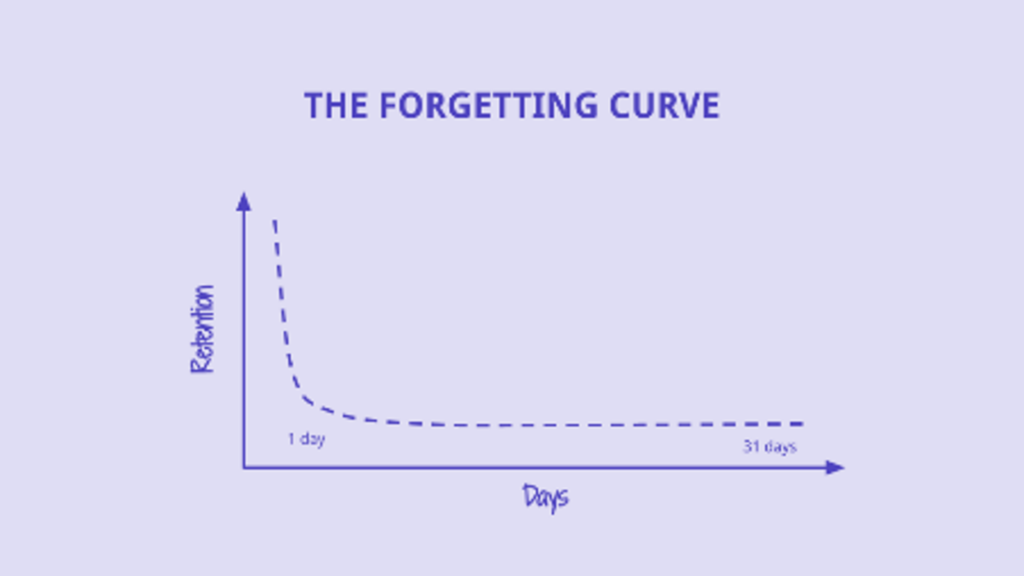
Hermann Ebbinghaus was a psychologist, specialising in memory. He used to test his own powers of recall by learning (or trying to learn) lists of meaningless words. To his horror, he ended up forgetting:
- 50% within a day;
- 90% within a week.
His study has been repeated since, confirming Ebbinghaus’s (depressing) conclusion that memory fails at an exponential rate. Tracked on a chart, the forgetting curve looks like this:
How do I deal with this hard truth?
Well, the rest of our list can help. Anchoring. Deliberate practice. Eureka moments. These all strengthen recall. But the best way for moving knowledge into long-term memory is to stay in touch with participants. They’ll lock down lessons if they can revisit them now and then.
That’s why I make the case for ongoing support.
Instead of saying, ‘Bye! Take care!’ to a client after I’ve run a workshop, I pop up here and there. Participants might get a top tip in their inbox… be invited to a half-hour skills burst… have their work reviewed on a one-on-one call… There are few ways of beating the forgetting curve. It’s all part of making training stick.
There’s method behind the mayhem
It might feel like I burst out of Pinstripe Poet’s library to play games, present GIFs, and nerd out on language. But the structure of my workshops is scientifically sound. The sessions in my Classic Collection startle, sparkle and stick.